
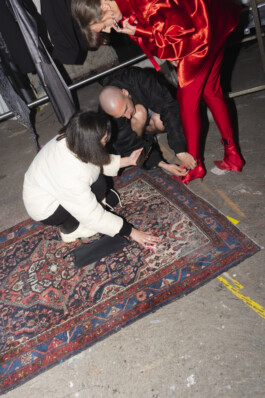
(DE-)MYSTIFICATION OF FASHION Happening, Photo: Alina Bäcker, Photo 2: Chulgyun Yoo,
Fashion: Jonathan Tschaikoiwski
From Circulation to Institution
Fashion usually operates through movement: through bodies, images, seasons and repetition. Exhibitions interrupt this movement.
By isolating garments from their habitual systems of use and mediation, exhibitions suspend immediacy. Fashion is no longer encountered as something to be worn or consumed, but as something to be observed.
This shift is not neutral. Context produces value. Institutional framing slows fashion down, stabilises it and assigns cultural weight.

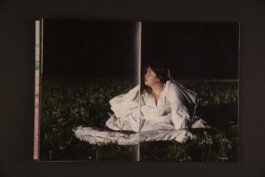
Breath Magazine vol 5, Model: Talia Ölker, Photo: Jonathan Tschaikowski
Exhibition as Institutional Frame
Exhibitions do not simply show fashion: they filter it.
Through selection, display and narrative framing, institutions determine what becomes visible, relevant or historical. Authorship is consolidated, temporality is extended, and fashion is aligned with cultural legitimacy.
At the same time, institutions absorb fashion’s visibility and contemporary relevance. The exchange is mutual and strategic.

Models: Hyunjin Lee and Jeonglim Baek, Photo & Layout: Chulgyun Yoo,
Fashion: Jonathan Tschaikoiwski
Spectacle and Legitimacy
Events such as the Met Gala demonstrate that exhibition and spectacle are no longer opposites.
Here, institutional framing does not interrupt circulation: it amplifies it. The museum becomes a stage, the opening becomes a media event, and legitimacy is produced in real time through global image distribution.
Fashion does not slow down within the institution. It accelerates through it. Exhibition, celebrity performance and image circulation collapse into a single system of validation.
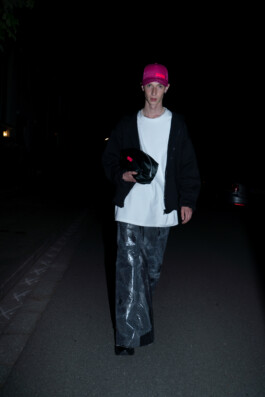
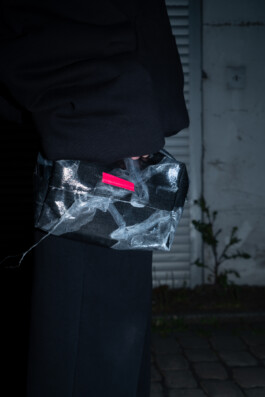
Model: Frido Heinz, Fashion & Photo: Jonathan Tschaikowski
Tension and Loss
Exhibiting fashion exposes contradictions.
Garments designed for movement are immobilised. Materials meant to age or wear are preserved. The body is absent, yet constantly implied. Fashion’s force shifts from use to display.
These tensions are not failures. They reveal how meaning changes when fashion moves from practice to institution and how dependent fashion remains on circulation, even when framed as culture.
Raumkörper, socio-political dance performance,
Direction: Sarah Schurian, Film: Frederic Hermann,
Fashion: Hyunjin Lee, Clara Marita Elaine and Jonathan Tschaikowski
Closing
expensive art and cheap wine does not reject exhibiting fashion. It isolates its effects.
By understanding exhibitions as sites of translation, legitimisation and spectacle, fashion can be read not only as object or image, but as a practice reshaped by institutions, publics and power.